Zekang Zhang
Zekang Zhang - Cosmology & AI
I'm a PhD researcher at the University Observatory Munich, LMU, in the Astrophysics, Cosmology and Artificial Intelligence group with Daniel Gruen, finishing in 2027. My projects move between pixels, catalogues, modeling and parameter inference. I build image simulations, machine-learning models, and statistical analysis.
I am interested in scientific ML and research roles with simulation, systematics, and uncertainty. At the moment I do: robust photometric redshift and shear estimation, cosmological inference from data.
Research
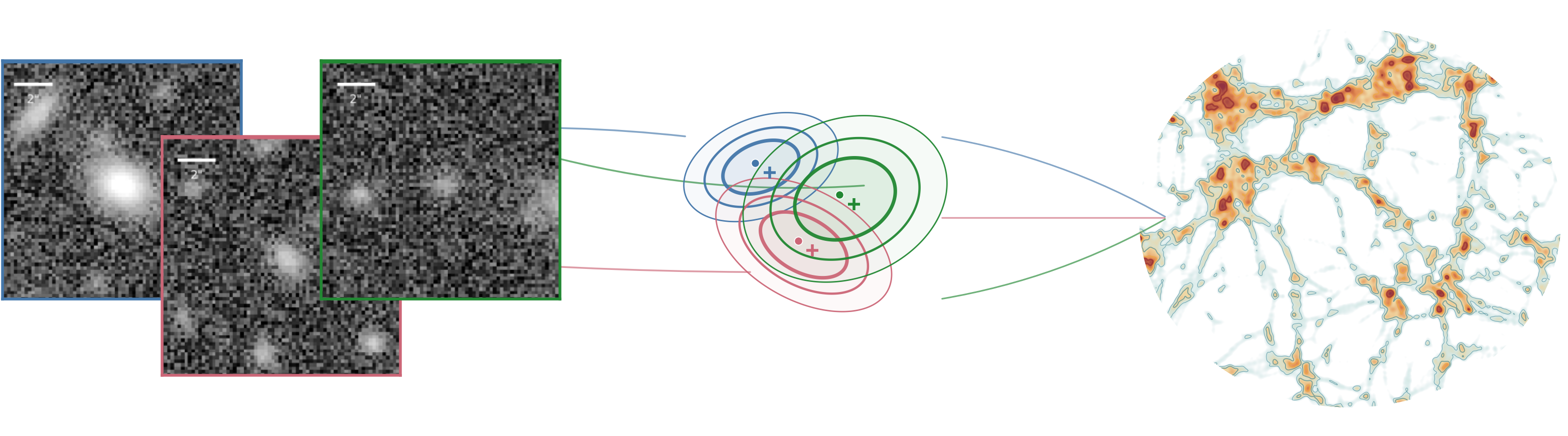
I work on photometric galaxy surveys, along six themes: image simulation, redshift estimation, shear calibration, image regression, machine learning, and statistical inference.
- Image simulation - how to fake a sky? Pixel-level forward modeling of galaxy surveys with full observational realism: blending, PSF, noise, detection, photometry, and selection effects.
- Redshift estimation - the distance of galaxies. Characterising redshift distributions n(z), SOM-based colour-redshift calibration, and spatial variation of n(z) from observational systematics.
- Shear calibration - galaxy light distorted by gravity. Weak-lensing shape measurement, shear response, PSF systematics, FORKLENS, and simulation-based shear inference with detection, selection and blending.
- Image regression - Calibrate image regression. FORKLENS uses a two-branch CNN to read a galaxy image and its point-spread function separately. Small neural networks then calibrate the ensemble and learn how much weight to give each object.
- Machine learning - Neuron-network-based Bayesian inference. A CNN-based shape measurement, and a shear inference framework built on image simulations with normalizing flows, folding detection, selection and blending into one model.
- Statistical inference - practical inference from data. Inferring cosmology from mock data when the data vector is biased by systematics: spatially varying observing conditions, their impact on two-point statistics, and what that means for combining clustering and lensing.
Selected Publications
- Anisotropic redshift distributions in photometric galaxy clustering and their cosmological impact (submitted to A&A)
- Emulating redshift mixing due to blending in weak gravitational lensing
- FORKLENS: Accurate weak-lensing shear measurement with deep learning
- Impact of the turnover in the high-z galaxy luminosity function on the 21-cm signal during Cosmic Dawn and Epoch of Reionization
More: NASA ADS, Google Scholar, GitHub.
CV
Contact
Email: zekang.zhang@physik.lmu.de
Address: University Observatory Munich (USM), Scheinerstr. 1, 81679 Munich. Room 222.